
As of Sunday 25 October 2026
Tax Deadline This Year. January is still ahead
You are standing on a Sunday and a tax date is coming. Which one is yours? Stand here with us: Thursday 15 October is behind you, extension or not. April is behind you and so is the balance that lived there. Friday 15 January 2027 is the date still ahead. We are Steven Palmieri, a Tax CFO, the Entrepreneur's CFO, and we close the books, set payroll up, and prepare the return that is still open.
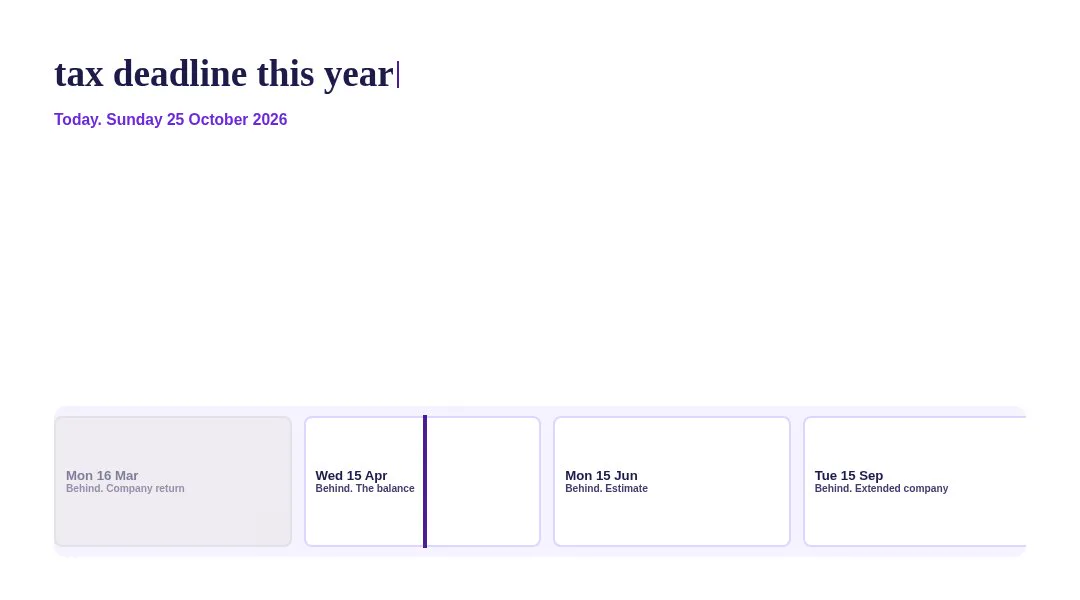
Name the return still open.
Say which return is still open. We match it to Friday 15 January 2027, or to the day that has already passed.
You will be talking to the Steven Palmieri practice.
The Tax CFO way with a deadline on the date still ahead.
A preparer files by the date. The Tax CFO looks past it: the January estimate that is still ahead, what this year's return should say before December, and how to never again stand on a Monday wondering which Thursday is yours. The date is the deadline. The plan is the work.

Thursday with an extension
Thursday 15 October 2026 has passed. An unsigned extended return is late.
Click to read which Thursday ›Tap to read which Thursday ›

The January estimate
Friday 15 January 2027 is the last estimate of 2026 for many filers, and it is still ahead.
Click to see the January date ›Tap to see the January date ›
April already behind
Wednesday 15 April 2026 has passed. A later signature did not carry the balance with it.
Click to see April behind you ›Tap to see April behind you ›
The March company day
15 March 2026 was a Sunday, so the company filing day was Monday 16 March, and that Monday is gone.
Click to read the March move ›Tap to read the March move ›
The payment stayed put
Moving the filing date did not move the day the balance was due.
Click to see the payment date ›Tap to see the payment date ›
The return still open
If the day passed and the return is unsigned, name the form before you name a new day.
Click to see what to bring ›Tap to see what to bring ›
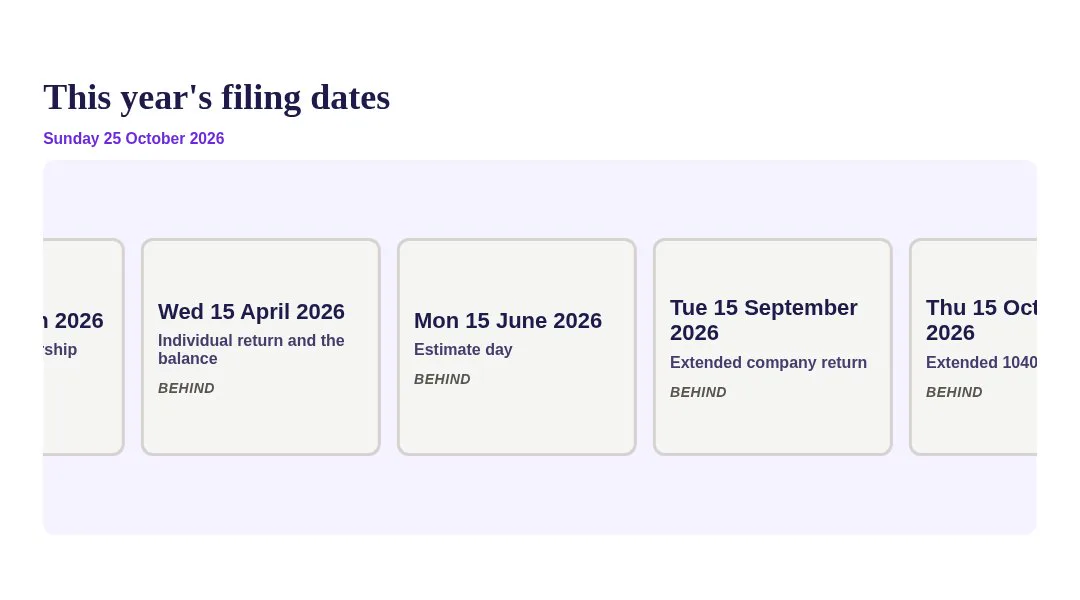
Six dates owners mix up
Six dates get mixed up in the same season. Open a card to see which return that date belongs to.
1Thursday, extension on file
An individual return that already has an extension
Thursday 15 October 2026 was the filing day that return pointed at, and that day has passed. What we draft next uses a month that already ties to the bank.
2January estimate still ahead
The last estimate of 2026, due Friday 15 January 2027
That Friday is later than this Sunday. We leave it on the list so a busy October week cannot hide it.
3April already past
A balance that belonged to Wednesday 15 April 2026
The April day has passed. We look at what was paid then, because moving the signature did not move the balance.
4Company return in March
An S corporation or partnership whose March day was a Monday
15 March 2026 fell on Sunday, so that filing day moved to Monday 16 March. That Monday is behind us.
5Payment that did not move
A payment date that stayed put while the filing date moved
On the call we separate the two dates, so a later signature is not mistaken for a later payment.
6Return still open
A return whose day has passed and whose signature is still missing
We name the form and the day it pointed at, then we say what a closed month still has to show.
Steven Palmieri.
Tax CFO. The Entrepreneur's CFO. We close the month, set payroll up beside your provider, and prepare the return that is still open.
Why April keeps showing up
Books are closed monthly. Payroll is set up, not run. The return we prepare is the one for the day still ahead. Thursday 15 October 2026 has passed. The April balance stayed on its own day. A list of tax dates that never says which day you are standing on will keep pointing at April, because April is the day people remember. On Sunday 25 October 2026 that memory is late. Wednesday 15 April 2026 has already passed for a 2025 individual return and for a calendar year C corporation return. If an extension was filed on time, the signature was due on Thursday 15 October, and that Thursday has passed. If it was not, April is the day the return was already due, and October did not reopen it.
Ask a narrower question than the full year. Which return is still unsigned, and which weekday does that return still point at. An individual return with an extension on file points at Thursday 15 October 2026. An individual return with no extension points at a Wednesday that is behind us. Those are different jobs, and a page that only shouts April cannot tell them apart.
We ask for the form first because the form picks the day. The books still have to be closed through the month you can stand behind. Payroll is set up with the provider you already pay, and that provider's deposit days are not this Thursday.
A shop can be ringing up today's sales and still have a return that points at Thursday. The receipt in the drawer and the signature on the return are both real. They are not the same afternoon, and a homepage that pretends they are will waste the week.
Thursday for the extended return
Thursday 15 October 2026 was the federal day for a 2025 Form 1040 when a timely extension was already on file. That Thursday is behind this Sunday. It was also the federal day for an extended calendar year Form 1120. The two forms shared a weekday this year. They do not share a story. One is a person's return. The other is a C corporation's return. Bring the one you actually file.
An extension changed the day the signature is due. The balance kept the April day it already had. If April's balance was short, the shortage has been sitting there since Wednesday 15 April 2026. Paying it on Thursday does not rewind the calendar. We will say that on the call before anyone treats Thursday as a fresh start for the money.
What we need in hand is last year's return, the extension acknowledgement, and a note of what was paid in April. A month that is still open in the books is not a month we will build the return on. Close that month first, or tell us it is still open so the scope can say so.
Owners sometimes arrive with a folder labeled extension and no copy of what was transmitted. The acknowledgement is the paper that shows the extension exists. A folder tab is a label you wrote. We follow the acknowledgement.
The company day that already passed
Calendar year S corporations and partnerships had a March filing day. 15 March 2026 fell on a Sunday, so the federal filing day moved to Monday 16 March 2026. That Monday is behind us. An extension from that day pointed at Tuesday 15 September 2026. That Tuesday is behind us too.
If the company return is still open after September, Thursday 15 October is not automatically the company's day. Thursday belongs to an extended individual return and to an extended calendar year Form 1120, and a company that missed September does not inherit that Thursday. An S corporation and a partnership that missed September are looking at a day that has passed, and the next step is to name that fact, not to borrow Thursday because it is close on the wall.
June 15 and September 15 of 2026 were also estimate days for many owners, and both have passed. We do not rebuild those quarters on this page. We ask whether they were paid, because a later filing does not replace a missed estimate.
A partnership and an S corporation can share a March habit and still differ in how cash left the company. The date on this list does not settle that difference. It only tells you the filing day has gone by.
January is still on the list
Friday 15 January 2027 is the last estimate day for the 2026 tax year for many individuals and for many corporations that pay estimates. It is still ahead of this Sunday. A person who spends the whole week on a passed Thursday can forget a Friday that is still ahead. We leave it on the list so the week of 25 October does not become the only week that matters.
The safe harbor for estimates looks back at last year's tax. A higher percent applies when last year's income crossed a line the instructions publish. We do not compute that percent from a guess, and we do not print a dollar figure you have not handed us. If you want the January payment sized, the closed books and last year's return are what the sizing stands on.
Farmers and fishers follow a different federal chapter. Their dates are not restated here. If that chapter is yours, say so in the note and we will treat Thursday's list as the wrong list for that question.
January is also when many owners finally look at whether estimates were even required. That question needs last year's figures and this year's closed months. It does not need a new nickname for Thursday.
Days in 2026 already behind
Several national dates in 2026 are already behind this Sunday. 31 January was the day many W-2 and 1099 forms were due. That day belongs to information returns and to payroll setup, not to the income tax Thursday on this page. Monday 16 March was the moved day for calendar year S corporation and partnership returns. Wednesday 15 April was the main day for individual returns and for calendar year C corporation returns. Monday 15 June and Tuesday 15 September were estimate days, and 15 September was also the extended day for those March company returns.
None of those days becomes Friday 15 January, because January is the date still in front of us. A return that was due on a passed day and was never filed is a return that is late. We can still prepare it. We will not describe it as if the original day were still waiting.
A declared disaster can give some people a later federal date. The IRS posts that date for the area it named. This page does not invent one, and it does not assume you are inside an area you have not named. If you think a posted relief date applies, bring the notice and we will read the date the IRS actually printed.
A weekend rule is the other quiet mover. When a federal day lands on a Saturday, Sunday, or legal holiday, the next business day is the one that counts. We have already applied that to March 2026. We do not apply it again to a Thursday that is itself a business day.
A later labeled year, named once
March 2027 and April 2027 are the next labeled year's main company day and main individual day. Monday 15 March 2027 and Thursday 15 April 2027 are real dates. They are not this site's subject. This site stops at the date still ahead of Sunday 25 October 2026, which is Friday 15 January 2027, and at the January estimate that belongs to the 2026 year.
A page that walks you through every 2027 weekday is a different reading. We name the two 2027 days once so you know we did not forget them, and then we come back to the return that is open now. If your only question is what 2027 will look like, say that in the form and we will not pretend Thursday is the answer.
Owners who just formed a company this autumn sometimes want both years explained in one sitting. We can name which year the first return belongs to. We still will not turn this page into a tour of next spring.
Payroll deposits are a different habit
Payroll deposits follow the calendar of the provider that runs payroll. Setup of that payroll happens beside the provider, and the deposits stay on their calendar. We do not process the deposits, and we do not turn a deposit day into an income tax day. Mixing the two is how a Thursday conversation gets crowded with a Friday payroll that was never this page's subject.
January information returns, including many Forms W-2 and 1099, were due at the end of January. If one of those forms is still open, it is its own job. Bring the list of who was paid. Do not assume the income tax extension covered it. An extension on Form 1040 moves that return's signature. It does not file a wage statement.
The books are the third habit. A month is finished when one balance is left, the bank's and the ledger's together. We draft the return only after that agreement exists. A receipt in a drawer is not a closed month. A shop that is still taking payments today can still have a return that was due on Thursday. The payments and the signature are both real, and they are not the same task.
If the provider's deposit calendar and the income tax calendar ever feel like one list, separate them on paper before the call. Two columns take ten minutes. Untangling them on the call takes the whole twenty.
When the return is still open
If the day has passed and the return is still open, the work is ordinary and specific. We name the form. We name the day it was due. We look at what was paid. We close the months the return will stand on, or we tell you a month is still open. Then we draft the return from the months that tie, and we talk through the decisions that can still be made while the year that is open can still be changed.
Look above this fold and the name is Steven Palmieri. You already met the Tax CFO title and the Entrepreneur's CFO title in that line. The call is where we line your form up with the day. A published page cannot see your extension, the April payment, or the last month you closed. The form lower on this page can carry those three facts as far as a sentence goes.
You will leave the call with one of three results. The Thursday filing is the right job and the records are ready. The Thursday filing is the right job and a month still has to close. Or Thursday is the wrong day and we have named the day that was yours. Any of those is a better ending than a list that only says April.
Decisions that belong to a year still open include timing of a known expense, a retirement contribution the plan allows, and whether an estimate for January should change because the year is no longer a guess. We do not invent a deduction to make a Thursday feel safer. Support has to come from months that have already tied to the bank.
A notice is not a new due day
A notice names a form and a period. Thursday moves only when that notice prints a different federal day. Read it for the form number and the year, and bring it. We match that form to the day on this list. If the notice is about a return that was due in April and never filed, the conversation is about a late return, not about an extension day you did not file for.
Interest and penalties follow the form instructions and what was paid. This page does not print a penalty amount, because a made up figure would be worse than silence. Bring the notice to the call and we will read the form number and the period printed on it.
Some notices are reminders of a date still ahead. Some are bills for a date that passed. The heading on the envelope is a poor guide. The form number and the tax period are the guide. Put those two in the note if you want the reply to start in the right place.
What the 30-minute call is for
The call runs about 30 minutes. We do not hold a slot until you pick one on the calendar. Bring last year's return, the extension if there is one, and anything you already paid toward April. If the books are open, say the last month that was closed. That is enough to tell whether January is your day, or whether Thursday already was.
A shop can still be taking receipts this week and still have a return that was due on Thursday. We will say which of those two the call is about before we ask for a file. If both need work, the letter that follows the call is where the scope splits them, not the first minute of the conversation.
You can also say you are unsure which form you file. That is a complete answer. We would rather start from uncertainty than from a guess that sends the week toward the wrong Thursday.
More of the list, including the days that have passed and the January estimate, sits on the dates still ahead. What to carry into the call sits on what to bring.
Tell us the form you file.
Name the form. We match it to Friday 15 January 2027, or to the day that has already passed.
You will be talking to the Steven Palmieri practice.